








As B2B companies scale their digital ecosystems, the technology stack can quickly become a tangled web of overlapping tools. One of the most common sources of confusion for business owners and sales directors is the difference between Marketing Automation platforms and Customer Relationship Management (CRM) systems.
While software vendors often blur the lines in their marketing pitches, these two systems serve entirely different primary functions. Misunderstanding their roles leads to misaligned teams, lost leads, and inefficient spending. Here is the definitive breakdown of how they differ, how they interact, and whether your business actually needs both.
1. What is Marketing Automation? (The Top of the Funnel)
Marketing automation software is designed specifically to feed the top of your sales funnel. Its primary goal is to capture anonymous web traffic, convert that traffic into known prospects (leads), and nurture them until they are “sales-ready.”
Think of marketing automation as a one-to-many communication system. It handles:
- Lead Generation & Capture: Managing landing pages, web forms, and pop-ups across your digital properties.
- Email Campaigns & Nurturing: Sending automated, behavior-based email sequences to thousands of prospects simultaneously.
- Lead Scoring: Assigning numerical values to leads based on their engagement (e.g., opening an email, downloading a whitepaper, visiting the pricing page).
- Segmentation: Grouping audiences based on demographics or behavior to deliver highly targeted messaging.
Popular examples: HubSpot Marketing Hub, ActiveCampaign, Marketo, Mailchimp.
2. What is a CRM? (The Bottom of the Funnel)
While marketing automation focuses on the masses, a CRM focuses on the individual. A CRM system is designed for one-to-one relationships. It is the central database where your sales team takes over to close the deal and manage the ongoing client relationship.
A CRM handles:
- Pipeline Management: Tracking exactly where a specific prospect is in the buying process (e.g., Contacted, Proposal Sent, In Negotiation, Closed/Won).
- Interaction History: Logging every phone call, direct email, and meeting associated with a specific client.
- Sales Forecasting: Analyzing the current pipeline to predict future revenue based on historical closing rates.
- Account Management: Storing contract details, renewal dates, and key contact information for post-sale support.
Popular examples: Salesforce, Pipedrive, Zoho CRM, HubSpot Sales Hub.
3. The Core Differences at a Glance
| Feature | Marketing Automation | CRM |
| Primary User | Marketing Teams | Sales & Customer Success Teams |
| Core Focus | Lead generation and nurturing | Closing deals and managing relationships |
| Communication Type | One-to-Many (Automated broadcasts) | One-to-One (Direct, personalized outreach) |
| Stage of Journey | Awareness & Consideration | Decision, Purchase & Retention |
| Key Metric | Conversion rates, Cost per Lead (CPL) | Win rate, Customer Lifetime Value (CLTV) |
4. Do You Really Need Both?
The short answer is: Yes, if you want to scale.
If you only have a CRM, your sales team will waste countless hours cold-calling uneducated leads. If you only have marketing automation, you will generate thousands of leads but have no organized system to close them, resulting in a chaotic and leaky pipeline.
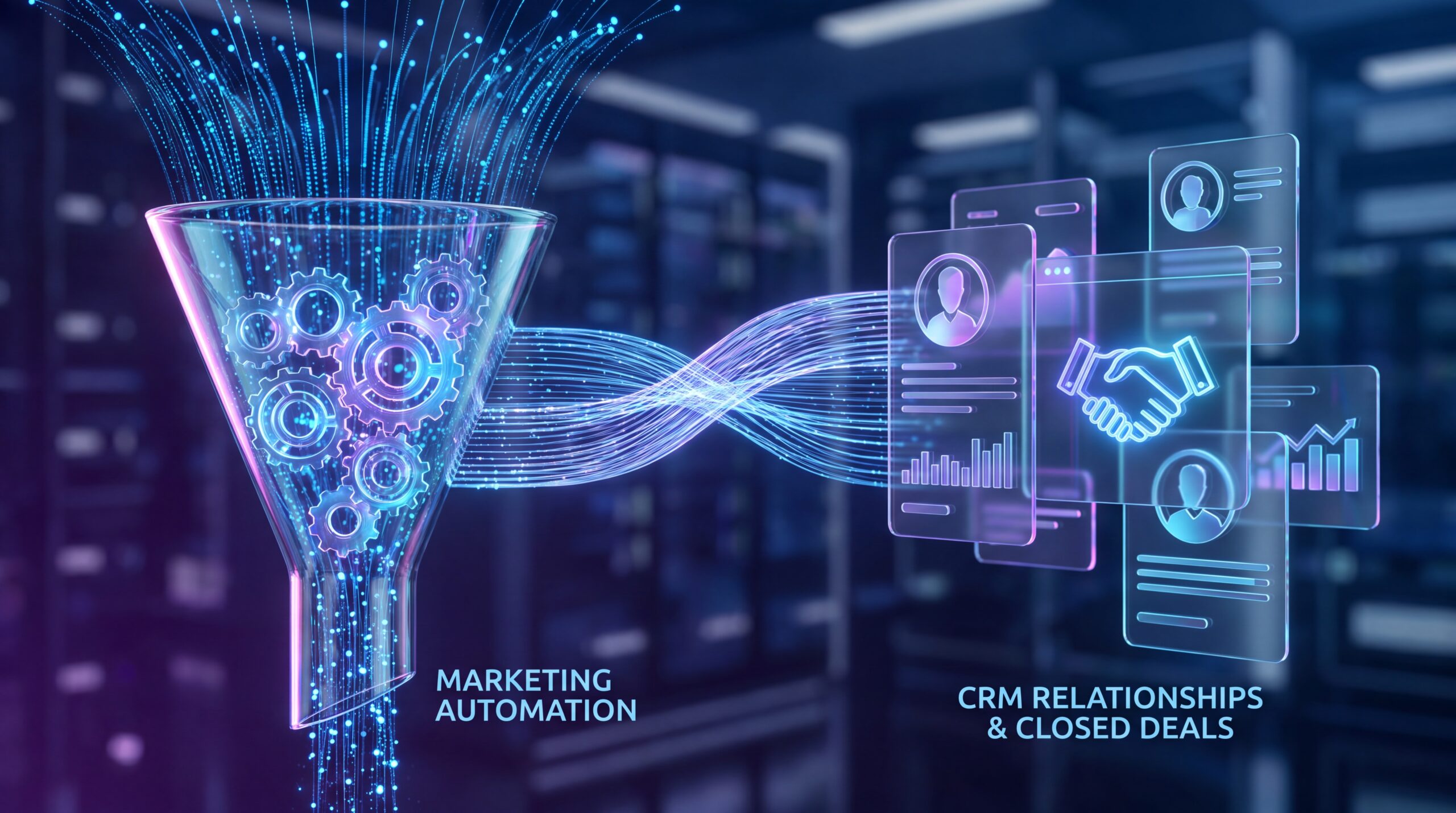
The magic happens when these two systems are seamlessly integrated.
The Ideal Data Flow
- Attract & Nurture: A prospect visits your website and downloads a guide. The Marketing Automation platform tracks this, adds them to an email sequence, and monitors their engagement.
- Qualify & Hand-Off: Once the prospect hits a specific “lead score” (e.g., they visit the pricing page three times), the Marketing platform automatically pushes their data into the CRM.
- Close & Retain: The CRM alerts a sales rep to call the prospect. The rep can see the entire history of what the prospect read and downloaded, allowing for a highly personalized pitch.
Conclusion
Marketing Automation and CRM are not competing technologies; they are two halves of the same revenue engine. Marketing automation cultivates the soil and plants the seeds, while the CRM harvests the crop. By integrating both into your digital infrastructure, you align your marketing and sales departments, ensuring that no high-value lead ever falls through the cracks.