








In today’s digital-first economy, your Customer Relationship Management (CRM) platform is the heartbeat of your business. It holds your most valuable asset: customer data. However, as cyber threats grow increasingly sophisticated in 2025, safeguarding this information is no longer just a best practice—it is a critical business imperative.
Failing to secure your CRM can lead to devastating financial losses, fractured customer trust, and severe regulatory penalties. To help you navigate this complex landscape, here is a comprehensive guide to fortifying your CRM data security.
Why CRM Data Security is Non-Negotiable
Before diving into the tactics, it is important to understand the stakes involved:
- Defending Against Cyberattacks: Hackers actively target CRM databases because they contain highly lucrative, sensitive information. A single breach can cause irreversible brand damage.
- Ensuring Regulatory Compliance: Stringent privacy laws like the GDPR and CCPA govern exactly how consumer data must be handled. Falling out of compliance guarantees massive financial fines.
- Preserving Consumer Trust: Customers expect their personal details to be kept strictly confidential. Demonstrating a commitment to privacy is a powerful tool for retaining long-term loyalty.
10 Core Strategies for Securing Your CRM in 2025
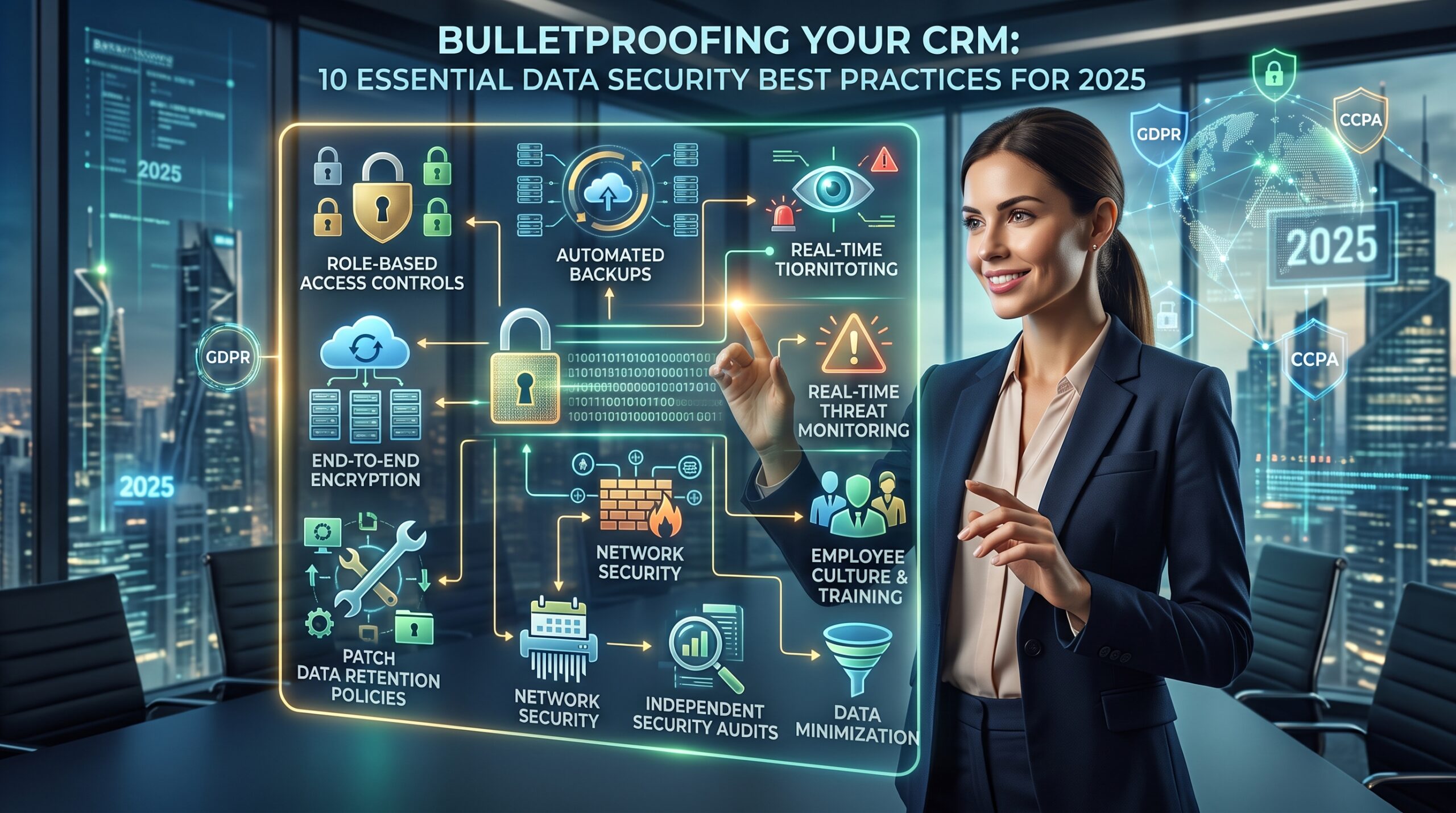
To build an impenetrable defense around your customer data, organizations must adopt a multi-layered security strategy. Implement these ten best practices to protect your systems:
1. Enforce Role-Based Access Controls (RBAC)
Never give every employee the “keys to the castle.” Implement strict access controls so that team members only see the data absolutely necessary for their specific roles. A marketing specialist does not need the same financial access as an accounting manager. Action step: Regularly audit user permissions and immediately revoke access for former employees.
2. Automate Redundant Backups
Data loss can happen through malicious attacks or simple human error. Establish a schedule of automated, frequent backups. To eliminate single points of failure, store these backups in multiple diverse locations, combining encrypted cloud storage with secure physical servers.
3. Mandate End-to-End Encryption
If hackers manage to intercept your data, encryption ensures they cannot read it. Verify that your CRM utilizes strong encryption protocols (like SSL/TLS) to protect data while it is in transit across networks, as well as when it is resting safely in your database.
4. Deploy Rigorous Patch Management
Outdated software is an open invitation to cybercriminals. Enable automated updates for your CRM platform to ensure critical security patches are applied the moment they are released. Pro-tip: Always test major updates in a safe staging environment before rolling them out to your live system.
5. Establish Ruthless Data Retention Policies
You cannot lose data that you no longer have. Create clear guidelines on how long certain types of customer information should be kept. Once data outlives its operational usefulness, run it through a secure, permanent deletion or archiving process.
6. Fortify Your IT Infrastructure
Your CRM is only as secure as the network it lives on. Protect your broader IT environment by deploying advanced firewalls, modern antivirus software, and Intrusion Detection Systems (IDS). Schedule routine vulnerability audits to find weak spots before attackers do.
7. Utilize Real-Time Threat Monitoring
Do not wait until a breach is publicly exposed to find out you were hacked. Implement intelligent monitoring tools that flag suspicious CRM activities—such as massive data exports or unusual login locations—in real-time. Pair this with a thoroughly documented Incident Response Plan so your team knows exactly how to react during an emergency.
8. Cultivate a Security-First Employee Culture
Human error remains the number one cause of data breaches. Conduct mandatory, recurring security training for your entire staff. Teach them how to spot phishing emails, the importance of strong passwords, and the exact protocols for handling sensitive client profiles within the CRM.
9. Practice Strict Data Minimization
Optimize your data lifecycle by collecting only what you actually need to serve the customer. Unnecessary data collection inflates your database and exponentially increases your liability if a breach occurs. Align your collection practices with core privacy principles like transparency and accountability.
10. Audit with Independent Security Experts
Internal teams can develop blind spots. To get an objective view of your security posture, hire third-party cybersecurity consultants to perform rigorous penetration testing. Use their external insights to continuously patch vulnerabilities and evolve your defenses.
Final Thoughts
As we move deeper into 2025, the responsibility of managing customer relationships goes hand-in-hand with the responsibility of protecting their data. By systematically implementing these ten security best practices, your organization will not only achieve regulatory compliance but also build a resilient, trustworthy brand that outpaces the competition.